 My clients often wonder how much more it costs to build their next home green. My builders are always trying to get the best green product at the lowest end cost. That's the way it has been and that's the beauty of green. Competition helps drive prices down! As a member of the Homebuilders Green council (Columbia SC) we are always working to make going green as inexpensive as possible. To that end we have re-developed our own local Green building and remodeling program. Our program is now based on the NAHB Green building Standard ICC 700-2008. With this system you can get as green a home as any of the other nationally administed programs, but a reduced program cost. That's how we roll in South Carolina, making green as affordable as possible! You can now get your home certified through this program for as low as $50 in administration fees! And if you've looked around at programs, that's incredibly cheap! Now you still have to build a green home and go through testing and verification to qualify, just like the other programs, but we feel like lowest cost is a good motivator. If you agree and are interested in this program contact Bin at www.columbiagreenbuilders.com to get your green project started! You can contact me at www.squareoneplans.com also!
Showing posts with label New Construction. Show all posts
Showing posts with label New Construction. Show all posts
Monday, January 30, 2012
Certify Green at the lowest cost!
My clients often wonder how much more it costs to build their next home green. My builders are always trying to get the best green product at the lowest end cost. That's the way it has been and that's the beauty of green. Competition helps drive prices down! As a member of the Homebuilders Green council (Columbia SC) we are always working to make going green as inexpensive as possible. To that end we have re-developed our own local Green building and remodeling program. Our program is now based on the NAHB Green building Standard ICC 700-2008. With this system you can get as green a home as any of the other nationally administed programs, but a reduced program cost. That's how we roll in South Carolina, making green as affordable as possible! You can now get your home certified through this program for as low as $50 in administration fees! And if you've looked around at programs, that's incredibly cheap! Now you still have to build a green home and go through testing and verification to qualify, just like the other programs, but we feel like lowest cost is a good motivator. If you agree and are interested in this program contact Bin at www.columbiagreenbuilders.com to get your green project started! You can contact me at www.squareoneplans.com also!


Saturday, July 2, 2011
Great green article

Got interviewed for a great article last month for Columbia Business Monthly on the topic of Green building in our area. Best in depth look at the progress we are making to date. I think the majority of the public will soon be exposed to how green building is giving us the tools to build and renovate homes in amazing new ways. Read the article and see how some of the front runners in this field are building vastly superior houses. After getting a feel for how well these new homes perform, maybe you will want a better performing home for your family! See the article at http://sctrend.net/
Green spec. homes selling faster

Well at least the last one I drew did. A great builder I know was looking to update his product line for a specific market in the Columbia area. He had a great lot in a great neighborhood, just needed a great home plan. The fact that he's one of my greenest builders didn't hurt either. He called to tell me that he was under contract before the windows were installed. He was excited. I was too! I went to take a few pics, and they were textbook green construction. Sealed crawl space, trusses and Tji floor joists, sealed shoe at exterior walls, great insulation job, tech shield sheathing on the roof,and zip wall sheathing for the walls. Energy star windows correctly flashed and sealed, and tight ductwork. Of course I'm super proud of the plan I drew him, but just as proud of the construction job he did. The new homeowner will easily have half the power bills of his neighbors! (more pics posted on my facebook page http://www.facebook.com/pages/Square-One-Design-Service/227662113916039
Tuesday, April 12, 2011
Green is changing the way we build.
Green building is having a huge effect on the way we build homes in South Carolina. Smarter home buyers are realizing that homes with energy saving features built in can save them tremendous amounts of operating and maintenance costs later on. Builders are realizing that buyers are really beginning to value superior construction again. I guess it took a little time, but savvy buyers are learning that all homes are not created equally, and builders are learning that better built homes do sell better than their energy inefficient counterparts. I am seeing this trend more often in the upper end market where I'm doing most of my work. Buyers have always looked for quality and have been willing to spend what it takes to get there. It the past, all you could buy was better trim, counter tops, cabinets and finishes. Nobody had the knowledge or the tools to measure the energy efficiency of a homes construction. We just did what the code said to do, and figured that was good enough. Now things are different. Programs such as Energy Star, LEED, and NAHB Green have taught builders and designers how to assemble the parts better resulting in energy savings sometimes as great as 50% lower power bills. That's really great considering that most of the time we're using the same materials and paying the same installation costs that we were before, we're just doing a better job at quality control, and getting a vastly superior performing home for about the same cost as before. The better builders are recognizing that attention to detail doesn't necessarily drive up the cost, but yields a vastly superior product. The buyers are agreeing with their pocketbooks. Smart home buyers are opting for the better built and performing product. How do you get in on the action? When you are looking for a builder, look for a builder who has experience in "green". He has the extra knowledge and training to build a home that performs to a higher standard.
Thursday, July 15, 2010
Sealing your ductwork
 I have found that the biggest savings on your electrical bills can come from the simplest things. Every time you turn on the media these days there are ads that tell you to upgrade to a more efficient HVAC system. There's a lot to be said about investing in a better unit. What's not mentioned so much is the ductwork for the unit. But when you want to save money that's the place you want to look first. I'm not sure about the rest of the country, but there's a lot of leaky A/C ducts around Columbia, SC. Everytime a friend of mine complains about the power bill, I suggest that we look. Some of them have the ductwork under the house. We open up the crawl space door and stick out heads under there. Cool under here isn't it? That's your air conditioning leaking out of the ducts. Usually I get an incredulous stare. What? That's not the real reason my A/C isn't working right is it? Can't be! For you guys that have your ductwork in the attic, crawl up there and have a feel around the joints while it's running. You might actually feel the air coming out of the cracks. Now think. If the air is leaking out up here, and the return air comes from inside the house, and there's not quite enough.... then the extra would get sucked in from .... outside. Viola! Now you realize that the best HVAC system that leaks maybe 15% of the air into the wrong place, is at least 15% less efficient than it's suppossed to be. Horrifying, but fixable. They make a mastic that the HVAC guy uses. Just start painting it around the leaks in the pipes. Don't forget the inside of the return where your filter goes, and the gaps around where the ducts enter the conditioned part of the house, either in the ceiling or in the flooring. If you really want to get serious about it, an energy rater can test the integrity of the ductwork with a ductblaster test. A trained HVAC guy can seal it up, and then they test again to see how much better it is. Best money you may ever spend.
Tuesday, November 3, 2009
Taking the first step to green.
Lots of people have been asking me about green lately. Almost everyone I design a home for says to me "if it saves me money on my power bills I'm interested." Then they start reading all of the stuff and become at least a little overwhelmed. So many choices. So many new ideas. Which ones work the best and which choices are more cost effective. You're gonna need some help and advice so you can spend your money the best way. A couple of great sources are your designer (like me), your builder of choice, and your energy rater. That's the guy who does all of the energy calculations for your project, and inspects the work for compliance along the way. I can tell you the path I took to go green, and your builder can tell you how they take the path to green, but the rater can compare different strategies to tell you the most cost effective path to green and that can be a great help. He can calculate before hand how much energy you'll save with a certain amount of fiberglass insulation vs a certain amount of spray foam insulation. When you compare that kind of information along side the builders price quotes for going either way the green path for your project starts to emerge on its own. The same concept can be applied for all of the green choices along the path. Window selection, appliances, HVAC equipment, all of that stuff. Remember to involve your energy rater early on and use his expertise and the expertise of your home designer to help you make decisions that will save you money. That's part of what you're paying him for.
Monday, July 13, 2009
Sealed fireplace units.

Those old woodburning fireplaces we grew up with sure were pretty. They made nice flames and a good crackle, but most of the heat went up the chimney. They also used oxygen from inside the house, which wasn't really a big deal, since there were lots of places for it to seep back in. Things are different nowadays, with a tight home you don't want anything taking the oxygen from your inside air. That's why they make sealed combustion units now. I got a great one by Majestic. It really looks great with a large opening and nice logs that run on propane. It's a sealed unit too, with a coating on the glass that makes it virtually invisible. Lots of people have tried to reach right through it! The outside air intake makes for sealed combustion and nice big flames. My wife just loves it.
Introducing fresh air

Another key component to green building is the periodic introduction of fresh air into the living space. There are several ways to do this, but I chose the Honeywell fresh air circulation unit for my new green home near Lexington,SC. It has several dials that your rater sets up for you based on your home's tightness, and other characteristics. The knobs adjust for cfms required, the number of bedrooms, and total home square footage. We ran a duct from the outside through the unit and into a shared supply for my two air units. The wiring hooks up to the HVAC air handler unit upstairs where the bedrooms are. Now the correct amout of fresh air is metered into the residence. Other things that are important are those energy star bath fans we talked about earlier, and a good range hood that vents to the outside.
Filtering the Air

Clean air needs filtration to stay that way. If you check out what you're filtering the air with now, it's probably those blue return air filters that they call "rock catchers" in the trade. A lot of guys switch to those pleated filters from 3M, and they're better, except if your HVAC unit wasn't designed for that sort of flow restriction. Green experts recommend that you opt for at least a MERV 9 filter. They really filter down to the really small stuff and they have a lot more surface area so they don't restrict the flow of air through the unit. Another way to go is the way I went, and that's electronic cleaning. The particles in the air are charged, then collect on a metal screen inside the unit. There's also a pre screen that you can take out and wash off and re-use. I cleaned mine the other day and it was easy. The unit I used is the American Standard Accuclean system. Their website says that it cleans 99.98% paticulates and over 99% of the common flu virus. We have 3 cats and a dog now and it seems to be doing a great job for us. They even make HEPA units that install into your sytem also, so make sure you address proper air flitration, when you think about HVAC.
Indoor Environmental Quality Stategies

For the next couple of posts we're going to talk about indooor environmental quality. When we built green near Columbia, SC we wanted clean safe, quality air inside. There are several ways to ensure this. One of the easiest is to control the moisture of the building components. When materials are delivered to the site, take steps to ensure they do not become exposed to the elements by covering them. Another great idea is to seal up your ductwork vents during construction. They make some duct caps for that, but I used some fortiflash tape to cover the floor ones. For the attic vents, my rater put some plastic over them when we tested, and I just left it there until time to install the register covers.
Wednesday, July 1, 2009
Water saving outside the home.
The exterior of a home can use as much water as the inside. Strategies include planting native vegetation that doesn't need supplementary water. If you're irrigating, you need to set up your turf zones separately from your planted areas, and use drip irrigation whenever you can to cut down on evaporation. Also, containing the rainwater from the roof for reuse is a cool idea. I'm not convinced rain barrels are the ticket, although I'm experimenting with one at my Gilbert,SC residence. I saw a program on TV where they said one inch of rain from a typical roof area can total 700 gallons. That's a lot of barrels. Of course they make underground tanks, and I saw a real cool bladder that goes under your deck and can easily store that much. I think for my situation it makes more sense just to get water from my pond and work with that. If I see some new products in this area I'll keep you posted...
Other inside water saving strategies

We talked about washers and water saving toilets, but there are some other things that save water in the home. Low flow fixtures for the sinks and showers, of course, but there are some other cool things you might want to think about. Green programs like for you to keep the water run distance under 30' between the water heater and the fixture that they serve so you don't waste water waiting for the heat to get to you. That could mean multiple water heaters or maybe a point of use model at a particular location. Another option is a recirculation valve. What these things do is pump the water from the hot side back into the cold side until the hot water reaches the fixture so none is wasted. You put the unit at the farthest fixture away from the heater. I heard that when they first started using them they had a little motion detector so that everytime you went into the bathroom it would come on automatically. Since you don't always use hot water on the way to the closet or to brush your teeth, a better option would be to just have an electrical button in a cabinet somewhere to manually operate it when you need it.
Tuesday, June 30, 2009
Energy star washers save water!

I thought those new washer dryer combo's looked pretty cool. They are pretty expensive though, lets look at some of the advantages. First they use lots less water. Lots. And with the super fast spin speed lots more of the water is removed already when they come out of the washer so there's less for the dryer to do. And you can get a lot more in it so there's less loads. As for the other advantages you'd have to ask my wife, because truthfully, she won't let me near it. Looks like I may have gotten the better end of this deal. We went with the Maytag EPIC Z. There were two series when we bought, the 400 and 600 series. We bought the 600 series. Also got those little boxes they sit on that raises them up higher. That's cool too. It's got more buttons and settings and sensors than the space shuttle. Can't really tell you about that stuff, but what I can tell you is make sure you take out these four special packing bolts in the rear or it will jump all over the room when the spin cycle starts up. An 11pm call to customer service got that worked out. Oops... Oh, one more thing, make sure you put the washer on the left and the dryer on the right, so the doors open correctly and not back to back. Happy washing from Gilbert, SC!
Water saving toilets do just that.

Water is a precious resource. Actually I should say clean water is a precious resource. The treated filtered kind. The kind you have to pay the utility company for. The same utility company that charges you again to get rid of the waste water. So using less water puts less stress on the water system, the aqufers and all of that, but using less water cuts down on your water bill. There are lots of ways to save, If you buy the right products you can save water and not even know it. Used to be that toilets had to have as much as six gallons of water to flush right. The unit I bought does the same job perfectly with only 1.6 gallons. I bought the TOTO brand because that's what I had in my old house and I was very pleased. When I was getting started I thought I wanted the dual flush one with two buttons, one for #1 and the other for#2. My supplier said they were having trouble getting them (Sept 2008), and said I'd be just as happy or maybe more with the ones that I got. Well all I can say is that I'm extremely happy, they flush just like my old ones except they only use 1.6 gallons. All in all I'd have to say that saving water by using a different toilet is pretty painless. Make sure you look for a water saving model when you are shopping
Tuesday, June 23, 2009
Energy Star dishwasher
Before I built my custom home near Columbia SC,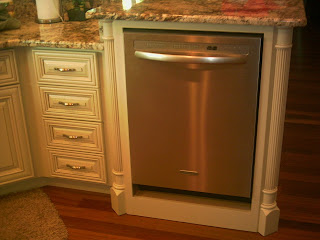

I hated my old dishwasher. Didn't matter that it wasn't my job to load it or unload it or anything like that. Thing was just too noisy. Couldn't even watch tv in the next room while it was on. Whenever I did dish washing I always used the sink so I didn't have to even turn it on. My new one is whole new deal though, energy star rated and super quiet. Our plan has a really open kitchen/great room area so a quiet dishwasher is really important, and this one is! You almost have to look at the indicator lights to tell it's even running. And with the energy star rating it uses less power and water than the one in my old house. Make sure you set aside some of your budget for one of these babies when you do your kitchen.
Energy Star appliances

I was reading the other day that some people were learning to live without a refrigerator. I can't quite figure out how you can save the planet turning off a device that only uses $70 worth of electricity in a year! That's all one of the new Energy Star refrigerators use each year! Much better than the old kind. All of the energy star appliances perform this way so make sure you look for them when shopping. I don't think they have energy star ovens yet, but every thing else you can find. One of the big mistakes people make though, when they get that new refrigerator, is putting the old one in the garage to keep beer in. That kinda defeats the purpose. Don't mean to say cold beer isn't a good thing, just look for another energy star fridge for the garage too! And then just to make sure you're doing your part to save the planet, maybe turn off cable news for a year, that ought to do it...
Thursday, June 18, 2009
Energy Star bath fans

An easy way to pick up some points on your green project is to use one of the new Energy Star bath fans in your project. Since energy efficient homes are tighter bath fans become more important for removing humidity. These new ones are lots quieter too. Lots of builders install them with little timers so they run the correct amount of time before turning off. Some of the special ones are integrated with the fresh air recirculation aspect of the HVAC system. If you're building a new home, or remodeling your bath, don't put a $10 fan in it, get a nice energy star one
Energy efficient lighting

One of the easiest things you can do to save some bucks and go green is to replace your light bulbs with green ones. When I built my new home in Gilbert SC, I was skeptical of CFL lights before I got used to them. Now I'm a fan. Mostly because of what it says on a typical package-"17 watts=65 watts". What this means is that you're getting 65 watts of light for 17 watts. Think about that. That's getting the same light for right at 25% of the money spent. That's great! But the next part is even better. Typical light bulbs put out about 10% of it's energy as light and the rest is heat. So if you're trying to keep your home cool in the summer the lights are working against you. So the 75% power savings is actually more! They have several types. The "energy star" lighting has prongs on the bulbs instead of screw ins, so you can't change back and forth. I've seen some really cool LED lights for cans but haven't bought any yet because of the cost. I went with the screw in CFLs. They make the little spiral jobs for regular stuff, lamps and the like. Then they make one that looks like a floodlight bulb for your can lights. Then I found some that are dimmable, because we like to dim all the can lights. Those are a little more pricey. And they don't dim down all of the way either. But, keep thinking about the energy savings and you'll get over it. In the beginning I was upset that they don't instantly get to their full brightness when you turn them on, but when you get up in the middle of the night to go to the bathroom it turns out to be a big plus. I got most of mine at the home depot, and they have a little display that shows the different colors of light that the different bulbs put out. The soft white ones are the ones closest to what you are used to. I was at Lowe's, and they had some with the candelabra attachment for ceiling fan lights, so I've got a few more to buy and try out. Anyway, start your conversion to CFL's and get started on lowering your power bill. And when your kid leaves the light on in his closet you don't have to scream and yell anymore 'cause it's only 15 watts! What a blood pressure saver!
Wednesday, June 17, 2009
Energy efficient equipment

Today I'd like to talk about some of the cool equipment that you can get for your new green home or remodel. This pic shows my Rinnai water heater next to my 16 SEER variable speed heat pumps. In the Southeast it's all about the AC baby. The great thing about these Rinnai units is that they only heat the water when you are using it so not only are they economical, you never run out. I got the R94 model. They can run on natural gas or propane. I've got propane. My distributor wanted to be safe and get me two of the smaller units since I have three baths and the master shower has all of those heads like a car wash, but the propane rep and I decided to chance it on the one big unit since they're not giving them away. Works great. Comes with a little indoor keypad so you can adjust the water temp up or down to where you like. I just set mine on 125 degrees and left it. My heat pumps are 16 SEER by American Standard. They have two stage drives so most all of the time they run at 70 per cent I think. That's when they run at all. Over the winter they didn't come on much, in the spring I hardly heard them at all. Now that it's June and 95 outside every day I'm starting to notice them. They still use a lot less juice than at my old house. As good as they are, I really think that most of the efficiency is in the fact that all of my duct work is sealed and located inside the building envelope. I've been going on remodel jobs from Forest Acres all the way to Lake Murray, where people are buying new units and not even checking the ducts for leaks. Nobody even mentioned it to them....Of course not! Fix the duct work and they might not even need the new unit!
Thursday, June 11, 2009
Correctly flashing windows

In an earlier post we talked about the drainage plane and why it's important. Windows are an obvious penetration to the drainage plane and you want to flash properly to keep the moisture on the outside of the structure instead of inside. Green builders in Columbia SC are being re-educated about flashing during their green training. Here's how it works. There are two kinds of rubber tape flashing that they use. One is ultra flexible and goes in before the window unit. It bends around the bottom corners of the opening. Watch your installer the first time so he stretches it instead of cutting it with a knife. Then you install the window over it and use the other regular flat tape to seal the sides and top. By using the correct installation order, the window and the tape funnel the water down and out like shingles on a roof. Do it wrong and you help to funnel water inside and behind your windows. Now your windows protect your drainage plane, and look how well the openings have been sealed against air infiltration!
Subscribe to:
Posts (Atom)

